Temper Your Expectations: What Outside Revenue Help Can and Can't Do

Many owners and presidents have never heard the word "fractional." They know consultants. They know recruiters. They don't know you can hire a seasoned CMO or CRO for a day or two a week, at a fraction of the cost.
That's not a knock on them. The fractional model grew up in venture-backed tech, and the numbers show it. One industry survey found 85% of fractional engagements were bought directly by founders or owners, and more than 90% of fractional leaders win work through referrals, not because buyers went looking. Another study found that most leaders can tell something is wrong, but only about 5% are actively shopping for a solution.
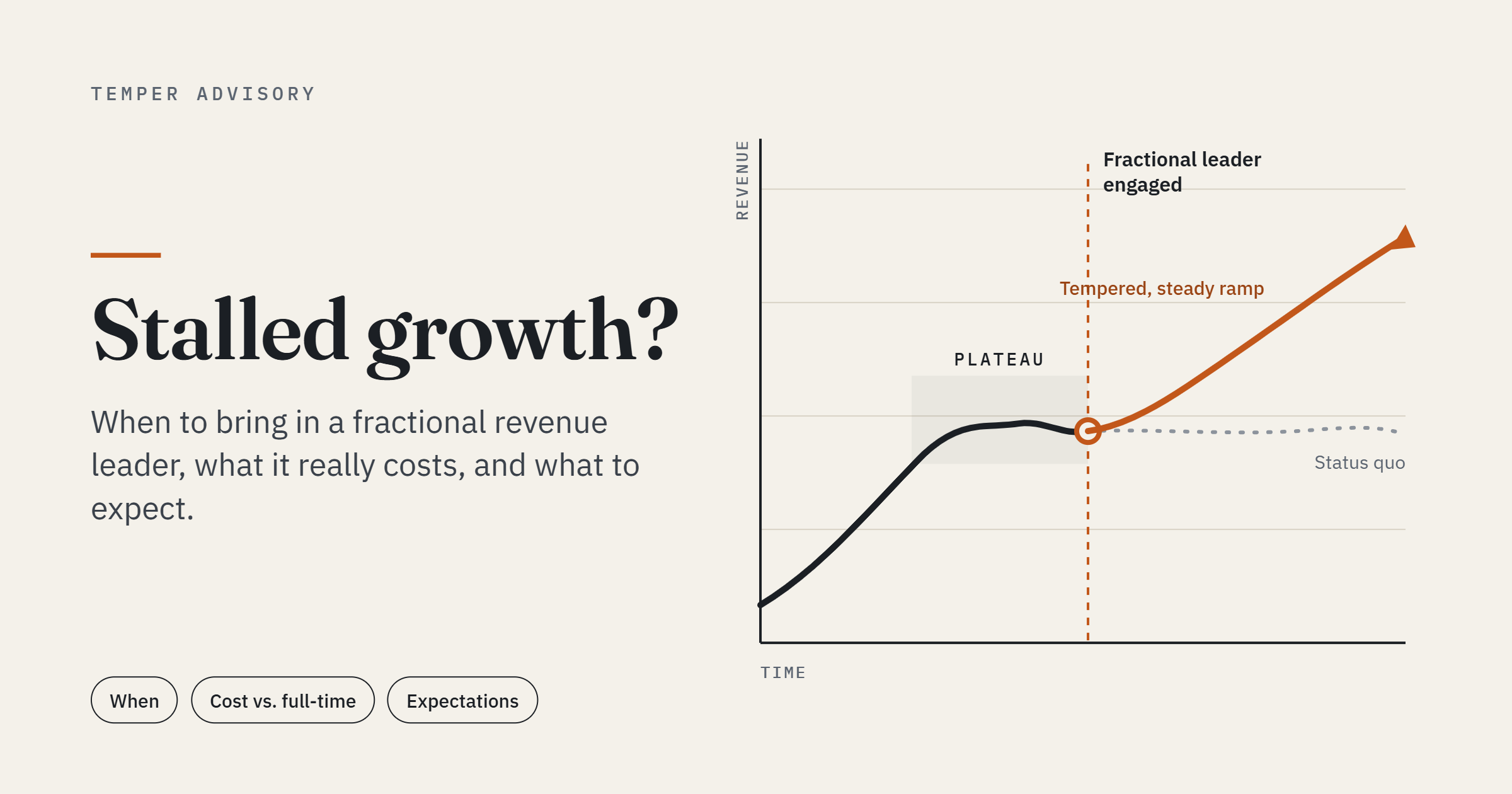
In mid-market manufacturing the gap is wider. The problem is familiar: growth has stalled, the sales team works hard but the pipeline is thin, the CRM is an expensive address book. The option to fix it without a $300K hire just isn't on the radar.
So this post does two things. It explains when you actually need outside help on sales and marketing. And it tells you, plainly, what that help can and can't do, so you go in with the right expectations.
Isn't fractional just consulting?
The primary difference between the two is that a consultant tells you what to do (rather, advises you), while a fractional executive decides what to do and executes it with you. A traditional consultant operates as an external advisor hired to solve a specific problem or deliver a strategy document. A fractional professional operates as a part-time, long-term insider embedded directly within your leadership team to run an entire business function.
It's also a cost decision. A fractional leader gives you executive-level experience for a fraction of a full-time hire, with no search fee, benefits or severance risk, and the flexibility to scale time up or down as needs change.
|
Consultant |
Coach |
Fractional executive |
|
|---|---|---|---|
|
Primary job |
Diagnose and recommend |
Build one leader's capability |
Lead a function, part-time |
|
Who executes |
Your team |
The person being coached |
Shared: leader directs, team executes |
|
Typical term |
Project, 1–6 months |
Ongoing sessions |
Retainer, 6–18 months |
|
Owns results? |
No, owns the recommendation |
No, owns the process |
Yes, owns the function's plan and metrics |
|
Best when |
You need an answer |
You have the right person who needs to grow |
You need the leadership, not just the advice |
Good engagements often blend all three. I'll diagnose like a consultant, lead like an executive, and coach your people so the capability stays when I leave. What matters is agreeing up front which hat you're paying for.
The four seats you can fill fractionally
Finance and marketing are the most common fractional roles; sales and revenue leadership is the fastest growing. One marketplace counted fractional sales leaders in the US and Canada rising from about 5,000 in 2020 to 9,000 in 2024.
|
Role |
What they own |
|---|---|
|
Fractional CFO |
Cash, forecasting, reporting, lender and investor readiness |
|
Fractional CTO/CIO |
Technology roadmap, systems, security, vendors |
|
Fractional CMO |
Positioning, demand generation, brand, marketing team and agencies |
|
Fractional CRO |
The whole revenue engine: marketing, sales, pricing, CRM and revenue operations |
The CRO seat is the one most mid-market manufacturers actually need, because their problems rarely stop at the line between marketing and sales.
What it costs, and where the savings really come from
A fractional revenue leader typically costs a third or less of a full-time executive in year one. The rough math for a mid-market company:
|
Cost item |
Full-time VP/CMO/CRO |
Fractional leader |
|---|---|---|
|
Base salary |
$200,000–275,000 |
— |
|
Bonus, benefits, payroll taxes |
$70,000–120,000 |
— |
|
Search fee (25–30% of first-year pay) |
$50,000–80,000 |
— |
|
Retainer |
— |
$60,000–120,000 |
|
Year-one total (approx.) |
$320,000–475,000 |
$60,000–120,000 |
The retainer is the smaller part of the savings. The bigger money is usually in what a seasoned leader stops you from spending:
- Hiring into a broken process. Adding reps before the sales process, territories and CRM work just adds cost. Fix the system first, then hire.
- Tool sprawl. Most companies I see pay for CRM seats nobody uses, overlapping marketing tools, or a new platform bought to fix a process problem.
- Unmeasured spend. Trade shows, agencies and ad budgets that renew every year without anyone tying them to pipeline.
- The mis-hire. A wrong full-time executive hire costs a year and often a multiple of salary. A fractional leader can define the role, and hire and onboard the right person when you're ready.
- Stalled deals and slow quoting. Tightening follow-up, pricing discipline and handoffs recovers revenue you've already paid to generate.
Signs you need help on sales and marketing
If three or more of these sound familiar, it's time to bring in experienced help:
- Revenue has been flat for two or more years while your market grew.
- Most new business comes from a few long-time reps or the owner's relationships.
- You can't say with confidence what's in the pipeline or what will close next quarter.
- Your CRM exists, but leadership still runs the business from spreadsheets.
- Marketing is a website, a trade show and a brochure, and no one can connect it to revenue.
- Sales and marketing blame each other for lead quality.
- You've lost a key account or two and didn't see it coming.
- You need a senior sales or marketing leader but can't justify, or find, a full-time one.
- You're preparing for a sale, a new product launch, or a new market, and the commercial plan is thin.
Notice that none of these is "we need more leads." That's usually a symptom. The cause is typically in the system: how you target, sell, follow up and measure.
What you actually get: experience and structure, not a silver bullet
No consultant walks in with the one idea that fixes everything. What a good one brings is pattern recognition and a way of working that makes improvement stick. In practice that means:
- A clear diagnosis. Where revenue is leaking, backed by your data, not opinions.
- A prioritized plan. A handful of changes in the right order, with owners, dates and measures.
- Process and systems that fit. A defined sales process, a CRM your team will use, and reporting leadership can trust.
- Project management. Someone who keeps the work moving when the day job pulls everyone away.
- A stronger team. Coaching for your managers and reps so the gains stay after the engagement.
- Cost discipline. A hard look at tools, agencies, trade shows and hiring plans, so every dollar of commercial spend is tied to pipeline and margin.
Why the background matters
Revenue problems don't respect org charts. A lead-quality complaint can be a targeting problem, a CRM problem, a handoff problem, or a pricing problem. A leader who has only run marketing, or only run sales, tends to find the answer in their own lane.
That's why I believe the right outside leader needs sales, marketing and revenue operations experience in one head, plus the discipline to implement. My own path covered sales, marketing, quality, CRM implementation, project management and executive leadership over 35 years in industrial manufacturing. Six Sigma taught me to measure before changing things. And I've seen enough implementations go well, and badly, to know the difference usually isn't the software. It's the process, the ownership and the follow-through.
Temper your expectations
Outside help works when both sides own their part. Here's what realistic looks like:
|
Timeframe |
What you should see |
|---|---|
|
First 30 days |
Diagnosis, quick wins identified, agreed plan and metrics |
|
60–90 days |
Process and CRM changes live, first reporting leadership trusts |
|
6–12 months |
Measurable movement in pipeline, win rate, margin or revenue |
And here's what the engagement needs from you:
- Access. To data, to customers, and to the people who actually do the work.
- Decisions. Recommendations stall when no one can say yes. Someone with authority has to own the changes.
- Time from your team. Change is done by your people, not to them. Plan for it.
- Patience with the right measures. Leading indicators like activity, pipeline quality and cycle time move before revenue does.
"It didn't work, so let's try another consultant"
I hear this often. A company brings in help, little changes, and they conclude they hired the wrong person. Sometimes that's true. More often the recommendations were sound, and they weren't implemented.
If you're on your second or third outside advisor for the same problem, look at the common factor before hiring the next one. Were decisions made? Did anyone own the changes? Did the team have time to do the work? Swapping consultants without changing those conditions buys you the same result at a new price.
About Temper Advisory
I started Temper Advisory to give mid-market industrial manufacturers the senior commercial leadership they need, without the full-time price tag. I work as a fractional CRO, CMO or CSO, leading marketing, sales and revenue operations as one system. Not every company needs a fractional leader, so I also offer project-based consulting, commercial diagnostics, project implementation (CRM, sales process, go-to-market), and facilitation of strategy and planning sessions. The goal is to match the help to the problem.
The name is deliberate. Tempering makes steel stronger and less brittle. It's also what I ask of every client: tempered expectations, a real plan, and the discipline to follow it.
If you recognized your company in the checklist above, let's talk. A 30-minute conversation will tell us both whether you need a consultant, a coach, a fractional leader, or none of the above. [Schedule a call → https://meetings-na2.hubspot.
Sources
- FRAK — State of Fractional Industry Report, Summer 2024 (founder/owner buyers, referral share)
- Think Fractional — The State of Fractional Consulting (buyer awareness: 80% see a problem, ~5% shopping)
- Vendux — 2024 State of Fractional Sales Leadership Report (5,000 to 9,000 fractional sales leaders)
- Over 50 Pros — Fractional Work: State of the Market, April 2026 (fractional cost ranges)
Full-time compensation and search-fee figures are approximate industry ranges, not from a single cited study.
Yes, some AI (or SuperIntelligence) was used to research and create this. AI can be a great producer, but doesn't replace the experience that tells AI what they missed, what doesn't fit and what should be the focus.